The best magnetic snap for journals depends on the cover construction, flap thickness and attachment method; no single closure suits every notebook. A slim notebook and a padded organizer can need different hardware even when they have the same page size. This guide compares five closure approaches rather than claiming that one diameter or an untested product is best for every journal.
Start with Richarms magnetic snaps and measure the finished cover, including lining, board and reinforcement.

1. Best Magnetic Snap for Journals: Low-Profile Prong Options
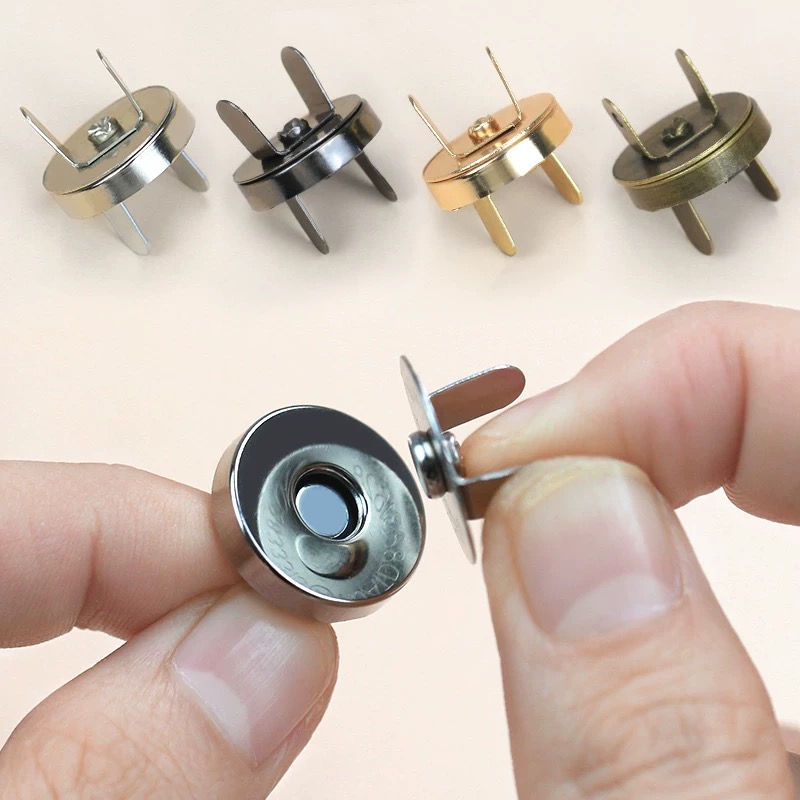
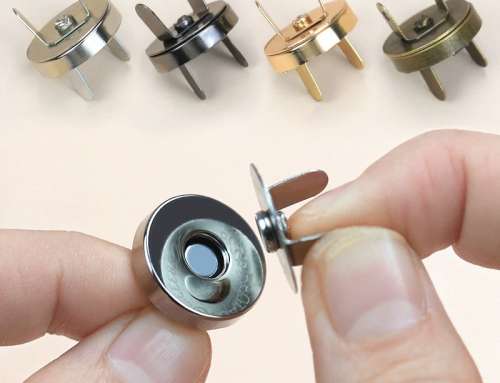
Prong snaps can suit covers with space to conceal the washer and folded tabs. Their visible profile, tab length and backing area should all be checked against the construction. They are useful when a maker wants a defined closing point and a relatively straightforward assembly method.
Do not select by the word “thin” alone. Our thin versus thick journal snap guide explains the difference between hardware thickness and the complete installed assembly.
2. Rivet-style magnetic snaps
A rivet-style option may suit a leather tab or a design with visible hardware on both sides. Match the post to the compressed material stack and check whether the back will touch pages, screens or other stored items.
Installation requires the appropriate tool and matching dies. Test the complete set on offcuts first; an existing press die is not necessarily compatible with a new snap.
3. Sew-in magnetic closures
Sew-in closures can work with fabric-lined covers or designs where the attachment area is sewn into the construction. Check the permitted stitch zone and avoid piercing the magnet enclosure. The sample should include the actual lining and seam allowance.
En sew-in magnetic closure overview provides more detail on this type of concealed construction.
4. Concealed magnetic closures between layers
A concealed closure keeps hardware out of view, but every intervening layer changes the magnetic gap. Board, padding and leather can make a magnet pair behave differently from the same pair tested face to face.
Secure the components against movement inside the cover. Do not rely on an untested adhesive-only arrangement, and confirm polarity before permanently closing the assembly.
5. Magnetic clasps for notebook straps
A strap clasp can become a visible design feature and provide a clear place to grasp when opening the journal. Consider the strap's length, flexibility and available gripping area as well as the clasp itself.
Compare our notebook magnetic clasp category when the strap is central to the design. The closure should accommodate the intended contents without pulling the cover out of shape.
Test before choosing a production model
Build one sample of each shortlisted approach. Fill the journal as intended, open it repeatedly, check lateral movement and inspect the cover around the fixing. Reject a closure that is difficult to open or progressively distorts the material.
Use the installation guide for assembly planning and the strength selection guide for testing the finished gap. Ask for model-specific dimensions instead of treating 10, 14 or 18 mm as a universal recommendation.
Browse the Richarms online magnetic snap collection for listed options, or explore Richarms on Pinterest for design references. Send your cover dimensions and material stack to discuss a sample.


 Spanish
 English
 French
 Italian
 Portuguese
 Turkish
 Korean
 Japanese
 German
 Dutch