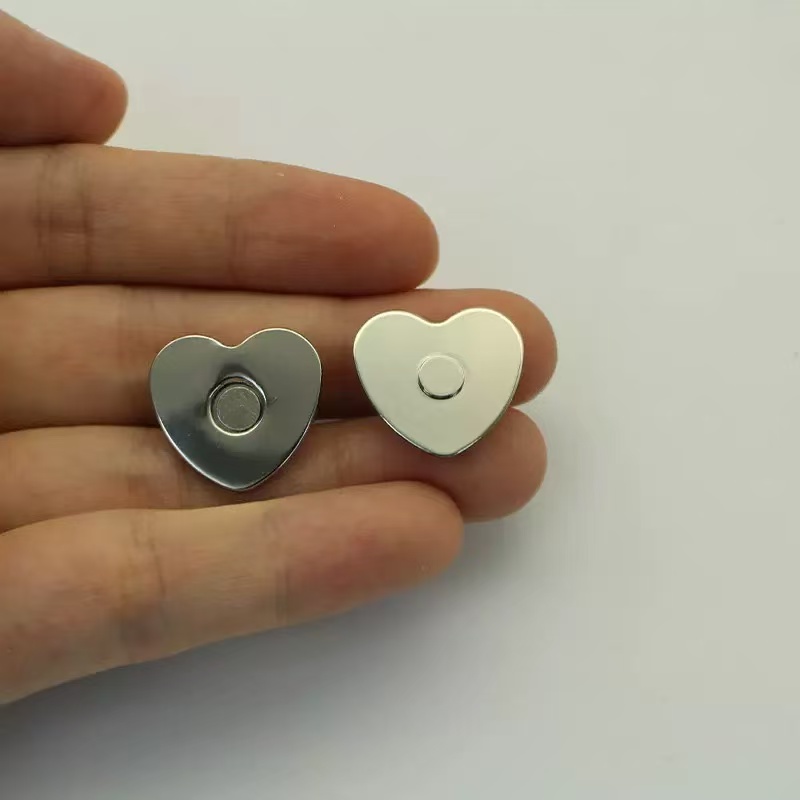
Choosing the right magnetic snap is not simply a matter of selecting the strongest magnet available. A magnetic snap that works well on a slim card holder may feel too aggressive on lightweight leather, while the same snap may become too weak when installed in a lined, reinforced, or padded handbag.
The most reliable way to select a closure is to evaluate the finished material stack, the weight of the flap, the intended use of the product, and the direction of force during use. This magnetic snap strength guide explains how leather thickness and construction affect magnetic closure performance in leather goods.
Understand the Effective Magnetic Gap
Magnetic snap performance depends on the distance between the two active magnetic components. In a finished leather product, this distance is usually greater than the visible leather thickness.
The effective magnetic gap can include:
- Outer leather
- Lining material
- Reinforcement leather
- Interfacing or non-woven backing
- Adhesive film
- Foam or padding
- Edge folds
- Metal caps or plastic housings
- Small air gaps caused by inaccurate alignment
A magnetic snap installed through 1.0 mm leather may perform strongly in an unlined card holder. However, the same snap can become noticeably weaker when used in a handbag flap with outer leather, lining, a reinforcement patch, and adhesive layers.
The important principle is simple: total construction thickness matters more than the thickness of the outer leather alone.
The goal is not to create the strongest possible closure. The goal is to create a closure that holds securely, opens comfortably, protects the leather, and remains stable during repeated use.
Match Snap Strength to Leather Thickness
Leather thickness provides a useful starting point for snap selection. However, leather density, tanning method, lining thickness, reinforcement, and product design must also be considered.
Thin Leather: 0.8–1.2 mm
Thin leather is commonly used for card holders, coin purses, slim wallets, notebook covers, and lightweight pouches.
For these products, small magnetic snaps in the 10–14 mm range are often appropriate. The closure should feel smooth and controlled rather than extremely strong.
A magnet that is too powerful can create several problems on thin leather:
- The user may need to pull too hard to open the product.
- The leather may stretch around the snap prongs or backing plate.
- The flap may deform after repeated opening.
- The lining may wrinkle or delaminate.
- The snap may leave visible compression marks on soft leather.
Thin leather products benefit from a compact snap, a properly sized backing plate, and a reinforcement layer behind the attachment area. The reinforcement should distribute force without adding unnecessary bulk.
Medium Leather: 1.2–1.8 mm
Medium-thickness leather is common in wallets, small crossbody bags, cosmetic cases, organizers, and light handbags.
For this range, magnetic snaps around 14–18 mm are often suitable, depending on flap size and lining construction. A lined product generally needs more holding force than an unlined product made from the same leather.
Medium-strength snaps work well for:
- Wallet flaps
- Small handbag closures
- Interior pockets
- Cosmetic pouches
- Small organizers
- Light crossbody bags
The installation area should be reinforced on both sides where possible. It is important to test the snap after the lining, edge finishing, and final assembly are complete. A snap that feels strong on a single layer of leather may feel weak once the finished construction adds several additional layers.
Thick Leather: 2.0–3.0 mm and Above
Thick leather is often used in structured handbags, satchels, briefcases, premium accessories, tool rolls, and unlined vegetable-tanned leather goods.
In thick leather constructions, a standard magnetic snap may lose much of its effective holding force because the magnetic components are separated by a larger gap. Simply choosing a stronger magnet is not always the best solution.
For thick leather products, consider the following options:
- Use a larger-diameter magnetic snap.
- Choose a stronger magnetic assembly.
- Skive or recess the installation area to reduce material thickness.
- Use a hidden magnetic plate rather than a standard prong snap.
- Add a mechanical closure such as a turn lock, tuck lock, buckle, strap, or zipper.
- Use the magnetic snap as a secondary alignment closure instead of the main load-bearing closure.
Very strong magnets can also create unwanted effects. They may be difficult to open, cause sharp impact when the parts snap together, mark soft leather, or place excessive stress on the installation area.
Choose Based on Product Function
The correct magnetic snap depends on what the closure is expected to do.
A magnetic snap is highly effective when it is used for flap retention, alignment, and convenience. It is less suitable when it is expected to contain a heavy load or resist strong pulling forces.
A magnetic snap should not be treated as a structural closure for every product. Large bags, backpacks, travel goods, and heavily loaded totes may experience forces that exceed what a magnetic closure can safely resist.
For these products, a magnetic snap can provide fast alignment and convenience, but a zipper, buckle, turn lock, strap, or other mechanical component should carry the main retention function.
Consider Flap Weight and Opening Direction
The weight of the flap is often more important than the size of the bag itself. A long, structured, or reinforced flap can create leverage that pulls against the magnetic closure.
The direction of force also matters.
A magnetic snap may perform well in a direct pull test but still allow the flap to slide or peel open under real use. This happens because magnetic pull force and sliding resistance are not the same thing.
A closure should be evaluated under several conditions:
- Direct pull force
- Vertical hanging force
- Sideways sliding force
- Repeated opening and closing
- Vibration during carrying
- Loading and unloading of the bag
- One-handed opening by the user
For example, a flap may stay closed when the bag is resting on a table but slowly slide open when the bag hangs vertically from a shoulder strap. In this case, the issue is not necessarily weak magnetic attraction. It may be low friction, poor alignment, flap leverage, or an unsuitable closure position.
Reinforcement and Installation Matter
A magnetic snap may have sufficient holding power but still fail because the leather around it stretches, tears, or pulls away from the backing plate. The attachment area must be reinforced according to the leather type and product structure.
Thin leather, soft chrome-tanned leather, stretch materials, and lightweight lining fabrics require additional support around the snap.
Suitable reinforcement materials may include:
- Split leather patches
- Vegetable-tanned leather washers
- Nonwoven reinforcement sheets
- Fusible interfacing
- Woven backing fabrics
- Thin thermoplastic reinforcement sheets
- Properly sized metal backing plates
The reinforcement should spread the opening force across a wider area. At the same time, it should not create a thick, soft layer directly between the active magnetic surfaces, because that can reduce magnetic holding strength.
A good reinforcement design is thin, stable, and wide enough to prevent tearing or distortion.
Prong-Mounted Magnetic Snaps
Prong-mounted snaps are widely used in wallets, pouches, and light handbags. They are fast to install and suitable for high-volume manufacturing.
They work best when:
- The material is thin to medium thickness.
- A backing plate is used correctly.
- The leather is reinforced.
- The slots are accurately cut.
- The snap is positioned far enough from the edge.
- The two mating components are precisely aligned.
Common installation problems include oversized slots, prongs placed too close to the leather edge, missing reinforcement, poor alignment, and backing plates that create pressure marks on the finished surface.

Sew-In Magnetic Snaps
Sew-in magnetic snaps are often used in fabric bags, soft leather goods, concealed closures, and premium lined products.
They are useful when visible metal hardware is not desired. They can also provide a softer visual appearance than prong-mounted snaps.
However, sew-in magnets should be carefully secured to prevent shifting inside the lining. The stitching area should be reinforced, and the total material thickness should be controlled to avoid excessive magnetic distance.
Recessed and Hidden Magnets
Recessed magnets are often used in luxury handbags and structured leather goods. They allow the closure to remain hidden while maintaining a clean exterior appearance.
This method can be especially useful for thicker leather, because the magnet can be placed closer to the mating surface. However, recessed installation requires accurate skiving, pocket cutting, adhesive selection, and magnet protection.
The magnet must be protected from cracking, rotation, and long-term movement. It should also be possible to repair or replace the component if necessary.
Test the Finished Product
The only reliable way to confirm magnetic snap performance is to test the finished construction. Supplier pull-force data is useful for comparison, but it is usually measured under ideal conditions with direct contact, flat steel surfaces, and straight pulling force.
A finished leather product introduces many additional variables.
Before approving a snap for production, test the following:
- Outer leather thickness at the closure point
- Lining thickness
- Reinforcement thickness
- Adhesive and backing layers
- Alignment between both snap components
- Direct pull resistance
- Vertical hanging performance
- Sideways sliding resistance
- Repeated opening and closing
- Leather stretching or tearing around prongs
- Surface compression marks
- Coating wear on the hardware
- Magnet cracking, loosening, or rotation
For factory development, it is useful to produce several prototypes using different snap sizes, magnetic strengths, and reinforcement structures. The best option should be selected based on the complete bag construction, not on hardware appearance alone.
A production-approved sample should clearly define the magnetic snap model, diameter, finish, installation orientation, reinforcement material, leather thickness, and lining structure.
The best magnetic closure is not necessarily the strongest one. It is the one that matches the leather thickness, total material stack, flap weight, and intended use of the product. A well-matched snap should close naturally, open comfortably, remain stable during use, and protect the leather over the full life of the item.


 French
  English
  Italian
  Portuguese
  Spanish
  Turkish
  Korean
  Japanese
  German
  Dutch
Dutch