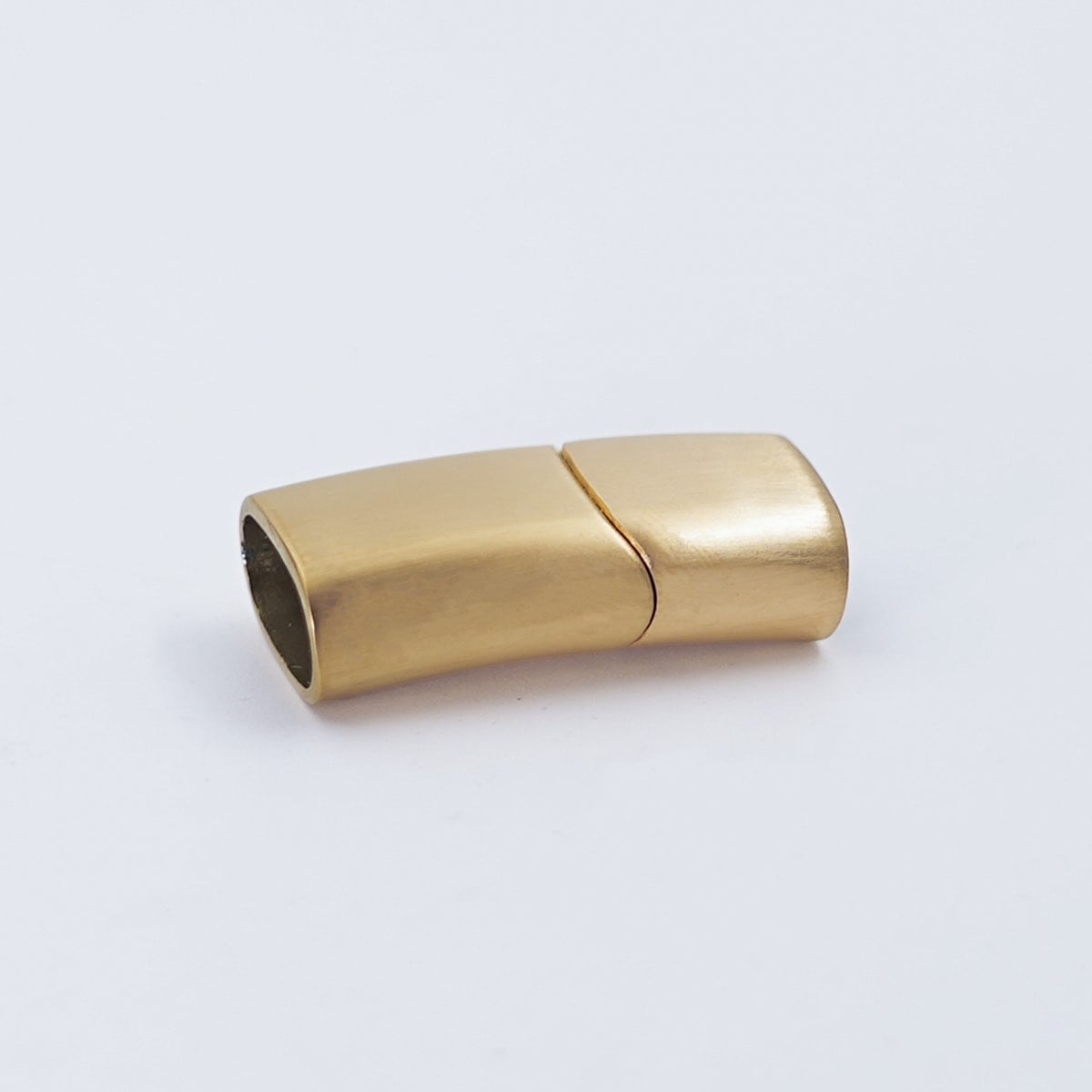
Not every bag closure brief is asking for a magnetic snap. Some specifications call for a lock-style or purse-clasp closure: a visible metal face, a particular outline, and a hardware role that sits with the rest of the bag’s metal fittings. That request may still involve a magnet, but it should not be treated as the same product family as a four-part magnetic snap with washers.
The published starting point for this kind of brief is the category of magnetic bag locks and purse clasps. The live category page describes zinc-alloy magnetic locks for handbag making, and states that the metal bag locks come in many shapes, sizes and colours. This article stays with that published description. It does not assign a locking mechanism, a security rating or a strength claim to any style.
What this category is for, and what it is not
A lock-style closure is usually specified when the hardware is part of the bag’s visible design, not only a concealed fastening. The face may need to match other zinc-alloy or metal fittings, sit on a flap or box lid as a design feature, or follow a shape that has already been approved in a design drawing. In that situation, starting from a standard magnetic snap can lead to a sample that functions as a closure but does not meet the specified appearance.
The zinc-alloy magnetic lock category is the place to begin that comparison. The live listing includes a range of published styles, such as C-shaped, half-moon, French square, round disc, chain-belt, square, diamond and heart faces, alongside other zinc-alloy lock and purse-clasp items. Those names describe the faces shown in the catalogue. They are not a description of how each lock engages, and they should not be read as a complete or permanent range.
This category should not be confused with the マグネットスナップ catalogue. Magnetic snaps are published for use as purse snaps, handbag closures, leather clasps, journal-cover locks, tote closures and other bag, packaging and leather-accessory applications, in a range of sizes and shapes. That is a different starting family. A brief that says “magnetic closure” without saying whether the hardware must be a visible lock face or a snap can easily be quoted against the wrong category.
When a lock-style specification is the right prompt
A lock-style brief is worth raising early when any of the following is already decided:
- the closure is a visible design feature, not a concealed snap under leather or lining;
- the shape, face size or decorative outline has already been drawn or sampled in metal;
- the hardware must sit with other zinc-alloy or metal fittings on the same bag;
- the article is a handbag, purse or box-style leather good in which the closure is specified as a lock or clasp rather than a snap;
- a logo or decorative face is part of the approved design, rather than an optional mark on a snap cap.
None of those points tells the factory how the parts engage, how much force the closure should have, or how the lock is fixed to the bag. Those details still have to come from the selected product page, a drawing, or a reference sample. If a specification uses words such as “lock”, “clasp” or “security” without defining the test, do not convert that wording into a rating. Ask what appearance, operation and fixing the sample must demonstrate.
What to take from a style page, and what to leave out
Once a category style has been shortlisted, read the individual product page for that style before writing the sample brief. Use only the facts that page actually publishes: the product name, the visible form, any stated material or finish options, and any dimensions that are clearly given as current figures for that item. If a page does not state a fixing method, a magnet arrangement, a dimension or a test, leave that item as a question in the brief rather than filling it from another style.
Custom design, finish and sampling are the right things to discuss at this stage. A production-intent sample should include the intended colour standard, any logo or face detail, the bag position in which the lock will sit, and the material stack at that position, because a decorative face still has to be mounted on a flap, rim or box lid.
Do not assume that a lock-style closure uses the same setting dies, prongs or washers as a magnetic snap. If tooling or a setting method will be required, that should be reviewed against the actual hardware and the intended machine or hand-tool interface, not inferred from a snap programme.
A conservative brief for sampling a lock-style closure
- State the article (for example a handbag flap, purse, or box-style leather good) and why a lock-style or purse-clasp closure has been specified.
- Say clearly that the brief is for the zinc-alloy magnetic lock category, not for a standard magnetic snap, unless a snap is also being compared.
- Identify any shortlisted catalogue style by its published name, or attach a drawing or physical reference if the face is custom.
- Record the intended set position and the finished material stack, including reinforcement and lining.
- Specify finish and colour against a standard or a reference, and note any logo or decorative face detail.
- Ask the factory to confirm the current dimensions, fixing method and operation of the selected item. Do not pre-fill those fields from another product.
- Define what the sample must demonstrate: appearance, alignment, how the bag opens and closes, and how the hardware is fixed to the material.
- Keep any operation check separate from fixing reliability. Do not add a security rating that the specification has not defined.
- Include sample quantity, target timing, and whether the sample is for design review or for production release.
Keep the two catalogues distinct as the programme develops
A lock-style closure and a magnetic snap may be compared on the same programme while the design is still open. What is not helpful is to merge the two catalogues in the brief, or to assume that a size, finish or setting method from one family applies to the other. Use the lock category when a visible zinc-alloy lock or purse clasp is specified, and the magnetic snaps category when the fastening is a snap. Confirm the selected item on an approved sample before mass production.
Richarms is a magnetic snaps manufacturer and custom bag hardware factory founded in Foshan, China, in 2003.

 Japanese
 English
 French
 Italian
 Portuguese
 Spanish
 Turkish
 Korean
 German
 Dutch