When you design a box closure, the first choice is magnet pair vs steel plate. Either two magnets attract each other, or one magnet closes onto a piece of steel. Both are common in rigid gift boxes, and neither is better in every case. This guide explains how each works, where each tends to cause problems, and how to compare them on sample boxes before you order.
Richarms makes magnets, magnetic snaps and custom metal closure pieces for packaging. We do not make boxes, and the box maker chooses the adhesive. The points below are about the closure components and how to test them, not a box design standard.
How a magnet pair closure works
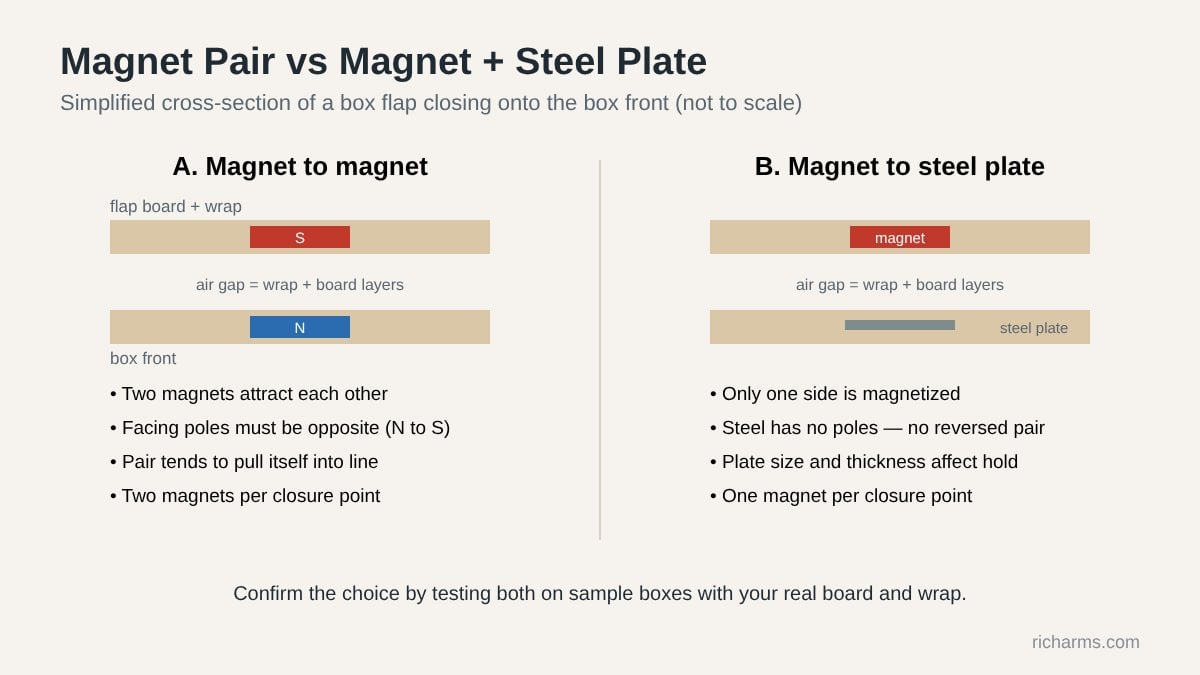
In a magnet-to-magnet closure, one magnet sits in the flap and a second magnet sits in the box front. When the flap closes, the two facing surfaces attract because they are opposite poles: north faces south.
What this means in practice:
- Two magnets per closure point. Every closure position needs a matched pair.
- Polarity matters on both sides. If one magnet is turned over, the pair pushes apart instead of closing. This is easy to miss on the line because the magnets look identical.
- Self-aligning tendency. Two magnets tend to pull toward each other’s center, which can help the flap settle in the same place each time.
- Attraction from both sides. Both parts are magnetized, so for the same magnet size a pair often closes more firmly than a single magnet on thin steel. Check this on your own samples rather than assuming it.
How a magnet and steel plate closure works
In a magnet-to-steel closure, only one side carries a magnet. The other side carries a piece of steel or another ferromagnetic metal. The magnet attracts the steel whichever pole faces it.
- One magnet per closure point. The other part is a plain metal plate.
- No reversed pair. Steel has no poles of its own, so the plate cannot be installed the wrong way round magnetically. The magnet still needs to be fixed securely, but its orientation will not stop the closure from working.
- Plate size and thickness affect the hold. A plate that is too small or too thin for the magnet can reduce the closing force. Include the plate in your sample tests.
- Less self-centering. The magnet will hold anywhere on the plate, so the flap position depends more on the box structure and the plate size.
Magnet pair vs steel plate at a glance
| Point to compare | Magnet pair | Magnet + steel plate |
|---|---|---|
| Parts per closure point | Two magnets | One magnet, one plate |
| Polarity risk in assembly | Yes, on both sides | No reversed pair |
| Alignment behavior | Tends to pull into line | Holds anywhere on the plate |
| What controls the hold | Both magnets, distance between them | Magnet, plate size and thickness, distance |
| What to check on samples | Every pair attracts; flap lines up | Hold with the real plate; flap position |
The table describes how the two designs behave. It does not rank them. Cost, appearance and closing feel depend on your box, so the final choice should come from sample boxes.
The distance between the parts matters in both designs
Magnetic attraction weakens as the gap between the two closure parts increases. In a rigid box, that gap is made of the wrap paper, any board layer over the recess, and anything else between the flap and the box front. Two closures that feel the same on the bench can feel very different once each part is covered.
For that reason, test both options with the actual layer stack. If you change the wrap paper or add a fabric lining later, check the closure again.
Reducing polarity errors with magnet pairs
If you choose magnet pairs, plan how the assembly team will keep the poles the right way round:
- Ask the supplier whether the magnets can be marked on one face, packed in matched pairs, or packed separately by pole.
- Use a reference magnet at the workstation to check which face goes up before fixing.
- Check every closure point on the first finished boxes, not only the first one.
Put the marking or packing requirement in your RFQ. Our RFQ checklist for magnets for rigid boxes lists the other details a supplier needs.
When each option may suit a box
A magnet pair may suit boxes where the flap should snap into the same position each time, or where you want both sides of the closure to contribute to the hold. A magnet and steel plate may suit boxes where you want to simplify assembly and avoid reversed pairs, or where only one side of the box can take a magnet recess.
These are starting points. Box size, filled weight, how often the box will be opened and the materials you use can change the answer. Build a few sample boxes with each option and compare them side by side.
How to compare the two on sample boxes
- Make sample boxes with the real board, wrap and adhesive, one set for each option.
- Use the same magnet size in both sets so the comparison is fair.
- Close each box from a small angle and from fully open. Note whether it closes on its own.
- Lift and tilt the filled box. Note whether the flap stays shut.
- Open each box with one hand several times. Note whether it is easy to open and whether the parts stay fixed.
- Check how the flap lines up with the box edge after closing.
- Keep the approved sample as the reference for production.
Frequently asked questions
Is a magnet pair always stronger than a magnet and steel plate?
Not always. A pair often gives a firmer close for the same magnet size, but the result depends on the magnet size, the plate, and the material between the parts. Compare both on sample boxes.
Can a magnet pair be installed backwards?
Yes. If one magnet is turned over, the two faces repel. Marking, matched-pair packing and checking every closure point help prevent it.
Can a steel plate be installed backwards?
Not magnetically. A steel plate has no poles, so the magnet attracts it whichever way it faces. It still needs to be fixed in the right position.
What magnets does Richarms supply for boxes?
We supply hidden magnets in round and square shapes, most often about 1 mm to 2 mm thick for box projects, as well as visible magnetic snaps and custom metal closure pieces. Sizes follow the customer’s design. If you also need the steel side, include it in your RFQ and we will tell you whether we can supply it.
Discuss your box closure
Send your box drawing, the closure positions and the option you are considering. Richarms can review the magnet size, pairing and sample plan with you. See our hidden magnets, read Invisible Magnetic Snaps for Gift Box Closures for packaging uses, or contact Richarms.


 Japanese
 English
 French
 Italian
 Portuguese
 Spanish
 Turkish
 Korean
 German
 Dutch