Choosing a front closure bra for surgery recovery requires guidance from the treating clinical team about fit, pressure, support and any medical-device considerations. Fit, support, pressure, wound location and any treatment-related requirements must be discussed with the treating clinical team.
For apparel designers, this article focuses on closure questions to bring into that process. Richarms supplies bra closure hardware; it does not prescribe a recovery garment or a compression level.
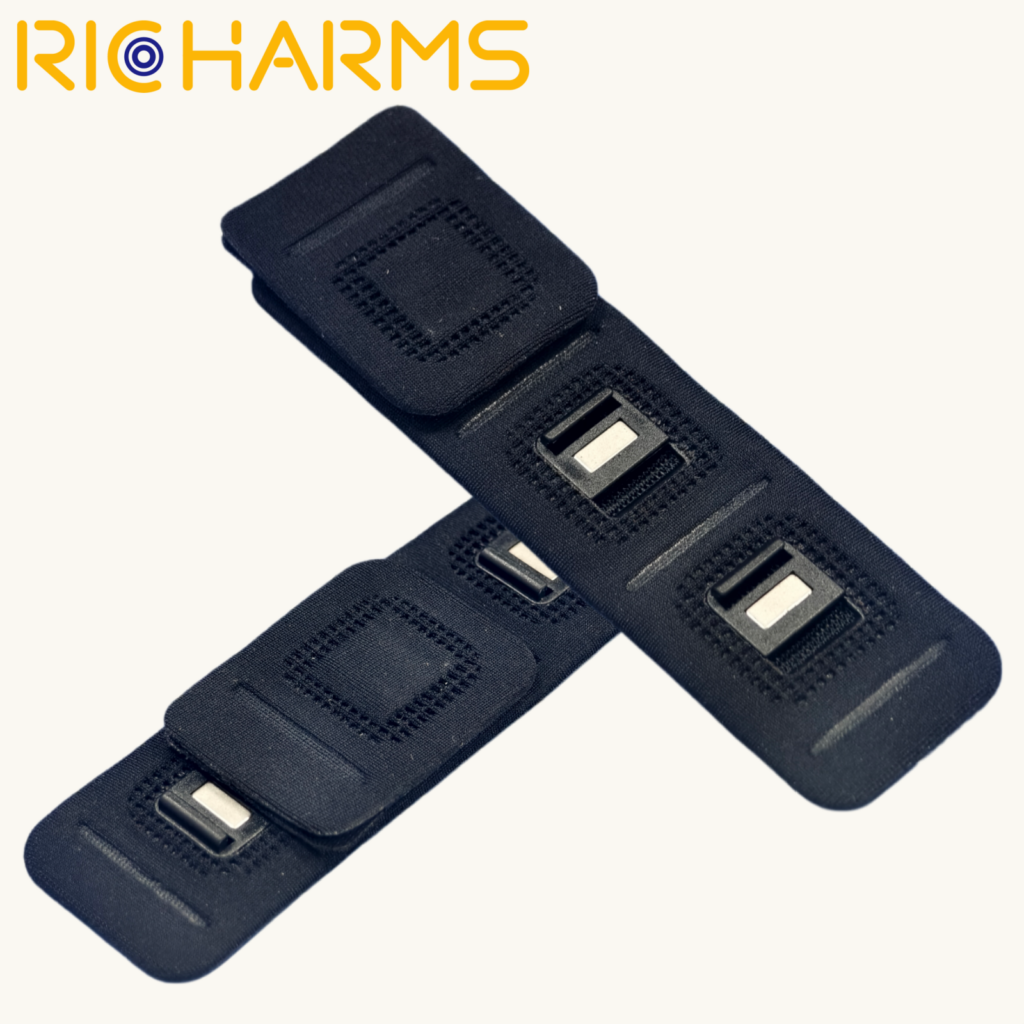
Choosing a front closure bra for surgery recovery
Ask what the intended garment needs to accommodate and which areas must avoid pressure or friction. Do not select a clasp and then assume the rest of the garment will meet those requirements. A front opening can be convenient, but its location may also place hardware near a sensitive area.
The user should follow their clinical team's instructions about garment type and wear schedule. A magnetic clasp should not be promoted as improving healing, reducing swelling or replacing a prescribed garment without appropriate supporting evidence.
Compare closure actions in context
Front hooks, zippers, nonmagnetic clips and magnetic-assisted clasps use different hand movements. Consider whether the wearer can see, grip and operate the closure in the expected position. Also assess how it will be opened when assistance is needed.
Nosso magnetic clips versus traditional hooks guide explains the mechanical differences. A product described as “front closure” is not automatically easy to operate with one hand or limited shoulder movement.
Check magnetic-device compatibility first
If the wearer uses an implanted or wearable medical device, consult the device guidance and treating clinician before considering magnetic hardware. A chest-mounted clasp needs particular attention because of its location. Use a nonmagnetic option if suitability has not been established.
Read the magnetic bra closure safety guide for the relevant precautions. Do not infer compatibility from a small magnet size or an unrelated consumer product.
Prototype the complete garment
For a brand developing a product, evaluate the clasp with the actual fabric, reinforcement, seams and intended band tension. Check that the hardware remains stable, does not pinch and does not create a concentrated pressure point. Test how it behaves under expected movement and after the intended care process.
Keep clinical or recovery-related claims separate from component specifications. A supplier can describe dimensions and construction, but a component drawing is not evidence of a finished garment's medical performance.
Related Reading
- Magnetic Bra Clip Supplier for Brands
- Por que o fecho magnético frontal do sutiã está revolucionando o conforto e o design do sutiã
Information to include in a sourcing request
- The closure position and available space.
- The intended opening and release action.
- Fabric and reinforcement details.
- Relevant garment requirements established by qualified advisers.
- Care conditions and inspection criteria.
- Any requirement for a nonmagnetic alternative.
O custom bra closure guide covers quotation and sample planning. See Richarms on LinkedIn for company information, or send a hardware development brief. Confirm the garment's suitability with the clinical team before treating a component sample as ready for recovery use.


 Portuguese
 English
 French
 Italian
 Spanish
 Turkish
 Korean
 Japanese
 German
 Dutch