Magnets for rigid boxes look like a small line item, but they decide how the finished box opens, closes and feels in the customer’s hand. When the closure is wrong, the fix usually means new samples, new board cuts or a re-wrapped batch. This checklist helps box makers and packaging buyers send a magnet RFQ that a supplier can quote accurately the first time.
Richarms is a magnet and bag-hardware factory in Foshan, China. For packaging projects we supply three kinds of parts: hidden magnets that sit inside the board, visible magnetic snaps, and custom metal closure pieces. We do not make the boxes. The box maker chooses the adhesive and the embedding method, so this guide focuses on the information the magnet supplier needs from you.
Decide which closure component the box needs
Start the RFQ by naming the component type. A finished-box supplier and a component supplier quote very different things, so “magnetic closure box” alone often brings back box prices instead of magnet prices.
- Hidden magnets. Thin discs or small blocks placed in a recess in the board, then covered by the wrap paper. The customer feels the closure but does not see it.
- Visible magnetic snaps. A two-part snap fixed to the flap and the box, often on a leather or fabric tab. The closure becomes part of the design.
- Custom metal closure pieces. A decorative metal part, such as a die-cast zinc alloy plate with a logo shape, that hides or carries the magnet.
If you are not sure which type fits, say so in the RFQ and send photos or a sketch of the box. It is easier to agree the component type before anyone discusses sizes.
Specify the magnet itself
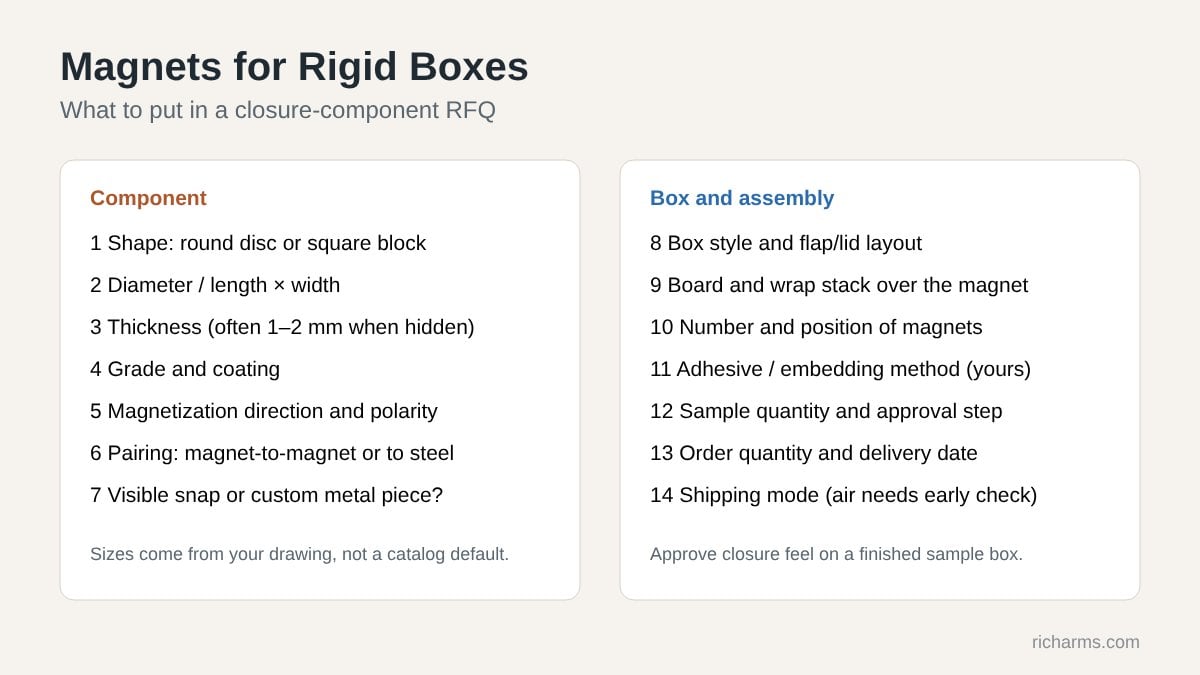
Shape and size
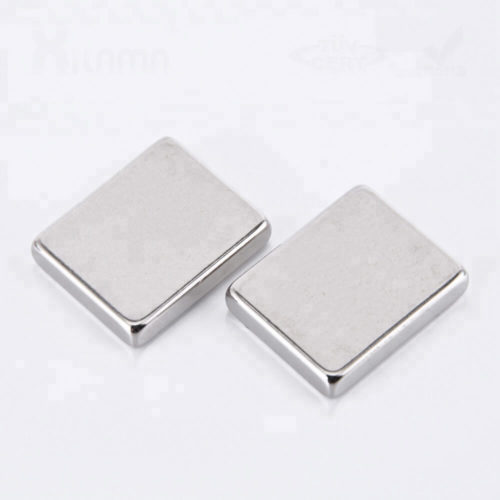
Hidden magnets for rigid boxes are usually round discs or square or rectangular blocks. Give the diameter, or the length and width, from your box drawing. Do not copy a size from another supplier’s catalog page; the right size depends on your board layout and the closing force you want.
Espessura
For magnets that are hidden inside the board, the projects we see most often use magnets about 1 mm to 2 mm thick. Treat that as a starting point, not a rule. The recess depth, board thickness and wrap all limit how thick the magnet can be before it shows through the surface.
Grade and coating
State the grade if your design already specifies one. If not, describe the closing feel you want and let the sample decide. Neodymium (NdFeB) magnets are normally coated because the bare material can corrode. Ask which coatings the supplier can offer for your size and confirm the choice on the sample.
Magnetization direction and polarity
Box magnets are usually magnetized through the thickness, so one flat face is north and the other is south. If the closure uses two magnets, the facing surfaces must be opposite poles. Say in the RFQ whether you need the magnets marked, packed in matched pairs, or separated by pole. This single line prevents one of the most common assembly errors.
Describe the pairing and the closing distance
A magnet can close against a second magnet or against a steel plate. Each option changes the part count, the polarity risk and the way the flap lines up. We compare them in detail in Magnet Pair vs Steel Plate: Choosing a Gift Box Closure.
Whichever pairing you choose, tell the supplier what sits between the two parts when the box is closed: board layers, wrap paper, fabric or film. Magnetic attraction falls as the distance between the parts grows, so a magnet that feels strong on the bench can feel weak once it is covered on both sides. A short note such as “magnet under 1 layer of wrap on the flap, steel plate under 1 layer of wrap on the front” is more useful than a target force with no conditions.
Give the box and assembly details
The magnet supplier does not need your artwork, but it does need enough of the box to judge the closure. Include:
- Box style, such as a book-style box, lid-and-base box or a box with a front flap.
- Outside size of the box and the flap, and roughly how heavy the filled box will be.
- Board and wrap materials, with the layer stack over each magnet position.
- How many closure points the box has and where they sit.
- How you will fix the magnets: recess and glue, tape, or another method. The adhesive is your choice, so tell the supplier the surface it must bond to on the magnet.
A simple drawing with dimensions and magnet positions marked saves several rounds of questions.
Check a visible snap or a custom metal piece
If the closure will be seen, the RFQ also needs appearance details: size, finish color, the fabric or leather the snap is fixed to, and how it attaches. For a custom metal piece, send the logo or shape artwork and the intended size. Custom metal parts generally need a tool or mold, so ask for the sample timing and the tooling arrangement in the quotation.
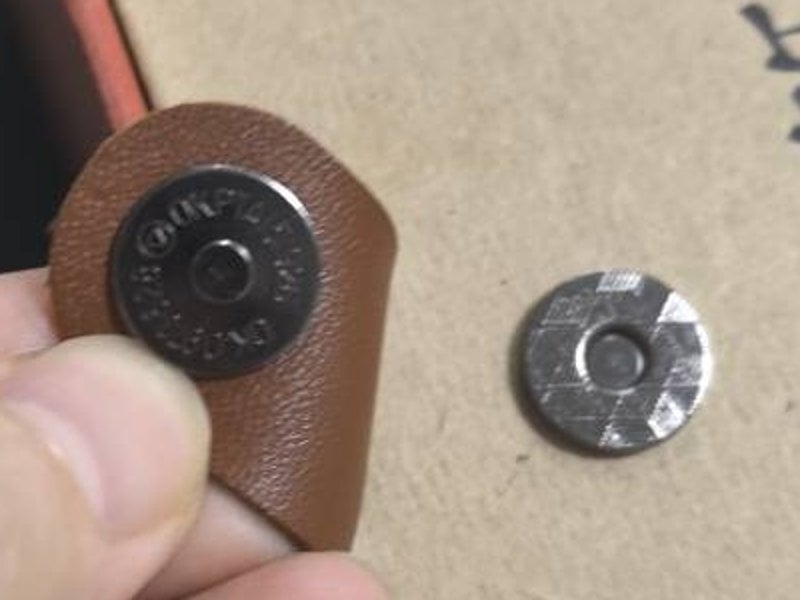
Visible snaps suit boxes that are opened often or reused, and boxes where the closure is meant to show. You can read more about snap styles in our guide to tipos de fechos magnéticos.
Plan samples and approval
Magnet samples on their own prove the size and finish. They do not prove the closure. Approve the closure on finished sample boxes made with your real board, wrap and adhesive. When you check the samples, look at:
- Closing feel. Does the flap close on its own and stay closed when the box is lifted and tilted? Can it be opened easily with one hand?
- Alignment. Does the flap line up with the box edge when it snaps shut?
- Surface. Can you see or feel the outline of a hidden magnet through the wrap?
- Polarity. Do all closure points attract, with none pushing apart?
- Bond. After repeated opening and closing, is every magnet still fixed in place?
Record the approved sample, keep one as a reference, and use it to check the first production lot.
Quantities, lead time and shipping
For standard Richarms items in standard finishes there is no minimum order quantity. Custom sizes, finishes and metal pieces are quoted per project, including the minimum quantity and lead time. Give the expected order quantity, the number of sample boxes you plan to make, and your production date so the quotation can be planned around them.
Magnets can need extra paperwork for air freight, and carriers set their own acceptance rules. If the parts or finished boxes will travel by air, mention it in the RFQ so the shipping method can be checked before the order is placed. The US Federal Aviation Administration explains the issue in its PackSafe guidance on magnets.
A copy-ready RFQ list for magnets for rigid boxes
- Component type: hidden magnet, visible snap or custom metal piece.
- Shape and size: round disc diameter, or block length and width.
- Thickness, and the recess depth available in the board.
- Grade (if specified) and preferred coating.
- Magnetization direction and how pairs should be marked or packed.
- Pairing: magnet to magnet, or magnet to steel plate.
- Layer stack between the two closure parts when the box is shut.
- Box style, box and flap size, filled weight.
- Number and position of closure points (drawing attached).
- Fixing method and adhesive you plan to use.
- Appearance details for visible snaps or metal pieces.
- Sample quantity and how samples will be approved.
- Order quantity and required delivery date.
- Shipping mode and destination.
Frequently asked questions
How thick are hidden magnets for rigid boxes?
In the box projects Richarms supplies, hidden magnets are most often about 1 mm to 2 mm thick, in round or square shapes. The final thickness depends on the board, the recess and the wrap, so confirm it on a sample box.
Does Richarms supply the adhesive?
No. The box maker selects the adhesive and the fixing method to suit its board, wrap and production line. Tell us what the magnet will be bonded to, and we can discuss the magnet surface and coating.
Can you make the whole box?
No. We make the closure components: magnets, magnetic snaps and custom metal closure pieces. The box itself comes from your box maker or packaging supplier.
Is there a minimum order?
Standard items in standard finishes have no minimum order. Custom sizes, finishes and metal pieces are quoted per project.
How strong should the closure be?
There is no single correct number. It depends on the flap size, the filled weight, the materials between the parts and how the box will be used. Compare sample boxes and approve the one that closes reliably and still opens easily. Our magnetic snap strength guide explains the factors involved.
Send your box closure RFQ
If you already know the box style and the closure positions, send the drawing and the details above. Richarms will review the component type, size, pairing and sampling plan with you. Browse our hidden magnets, see how invisible snaps are used in packaging in Invisible Magnetic Snaps for Gift Box Closuresou contact Richarms with your RFQ.

 Portuguese
 English
 French
 Italian
 Spanish
 Turkish
 Korean
 Japanese
 German
 Dutch