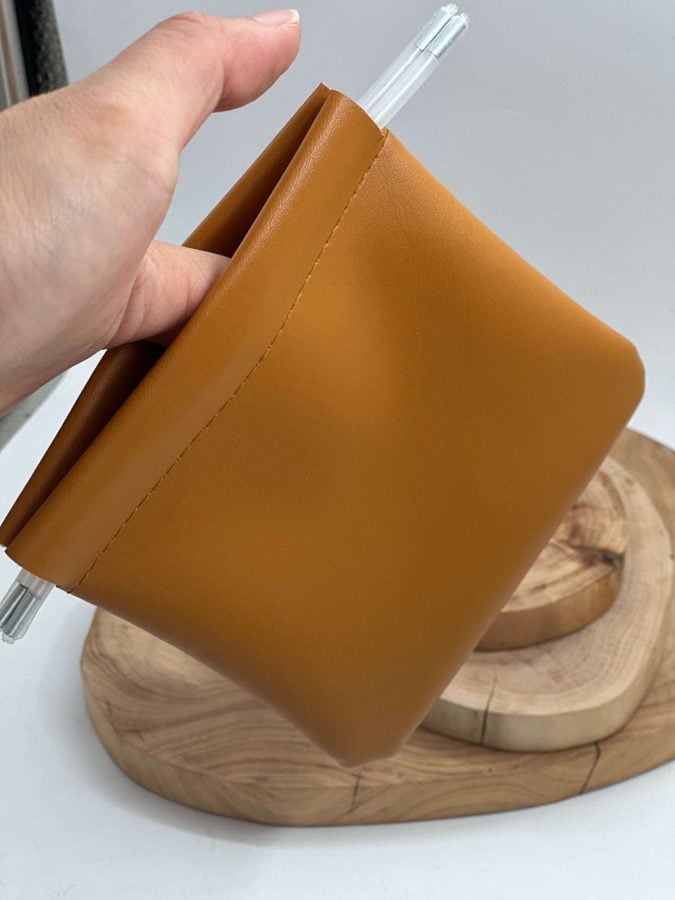
A magnetic closure strip closes a bag opening the way a zipper or a row of snaps would, but without teeth, a slider or visible hardware. The two edges find each other and close along their length. For bag, luggage and accessory brands, that means a hidden magnetic closure that is quick to use and quiet. It also means a component that has to be specified with care. This guide explains how a magnetic closure strip is built, how the internal arrangement changes its behaviour, where it works well and where we do not recommend it, and why magnets can sometimes shift inside the tube.
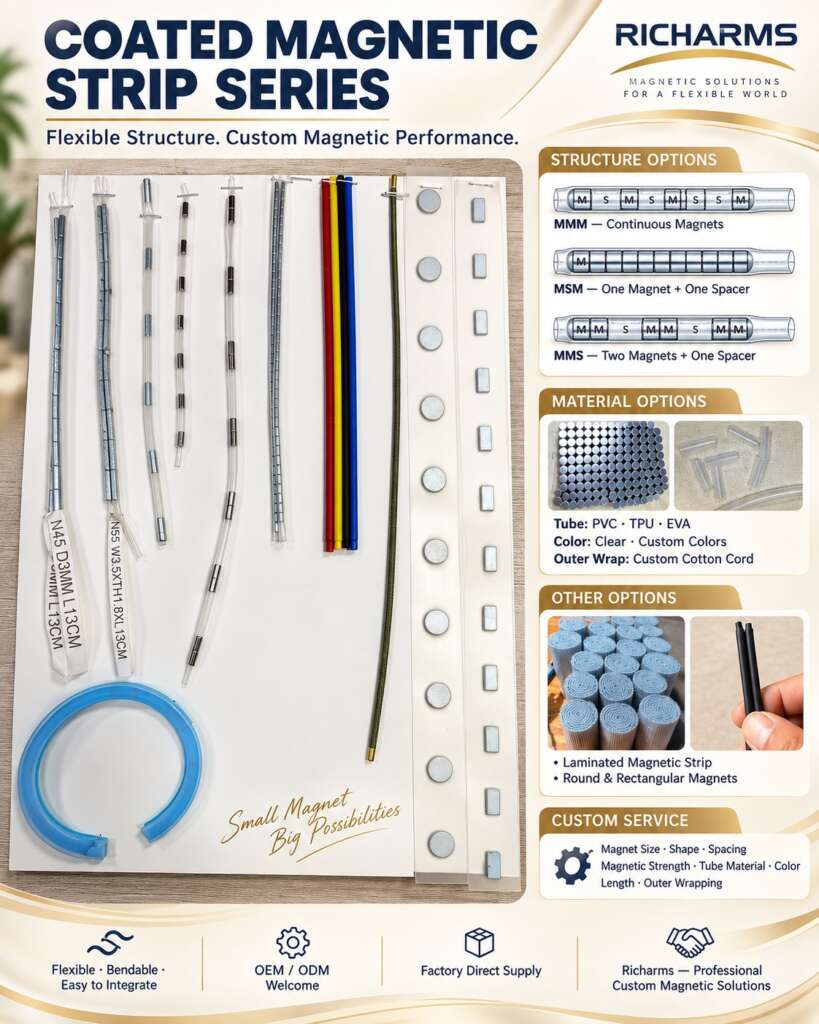
Custom PVC/EVA tube magnetic closure structures, magnet spacing and specifications for bags, pouches and soft goods.
Why brands look at magnetic closure strips
Buyers usually come to a magnetic closure strip from one of two directions. Some want to replace a zipper or a line of snaps on an opening that is used many times a day. Others want a closure that cannot be seen from the outside, so the bag keeps a clean line. Buyers often call it a magnet strip for bags or a flexible magnetic strip. They all mean the same idea: a flexible strip with magnets inside it, sewn or slid into the edge of the product.
Compared with a conventional zipper, a strip closes as soon as the edges are brought together, has no slider to catch on fabric and makes little noise. It can also follow a curved opening. What it does not do is lock: a strip holds by magnetic attraction, so the closing feel has to be matched to the product.
How a magnetic closure strip is built
Every strip has four parts, and each can be specified for the project.
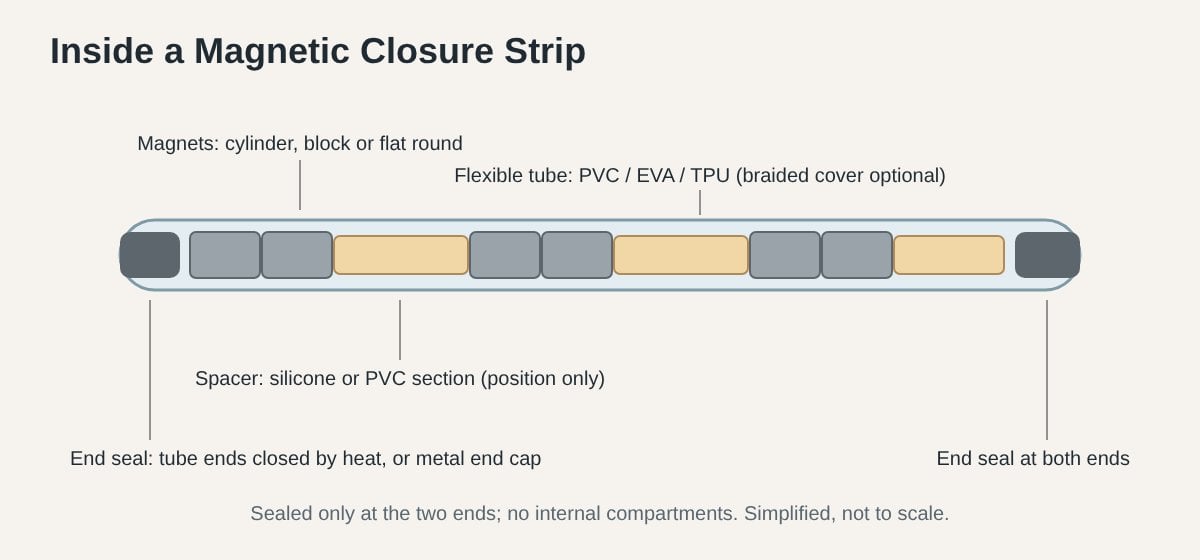
| Part | Options | What it decides |
|---|---|---|
| Flexible tube | PVC, EVA or TPU; a braided cover can be added, for example on jewelry cords | Hand feel, transparency and how the strip copes with its environment |
| Mıknatıslar | Cylinder, block or flat round; size made to the project | Closing strength and strip diameter |
| Spacers | Silicone sections or short PVC tube sections | Only hold position; they set the spacing and flexibility |
| End seals | Tube ends closed by heat, or metal end caps | Stop the row of magnets at both ends |
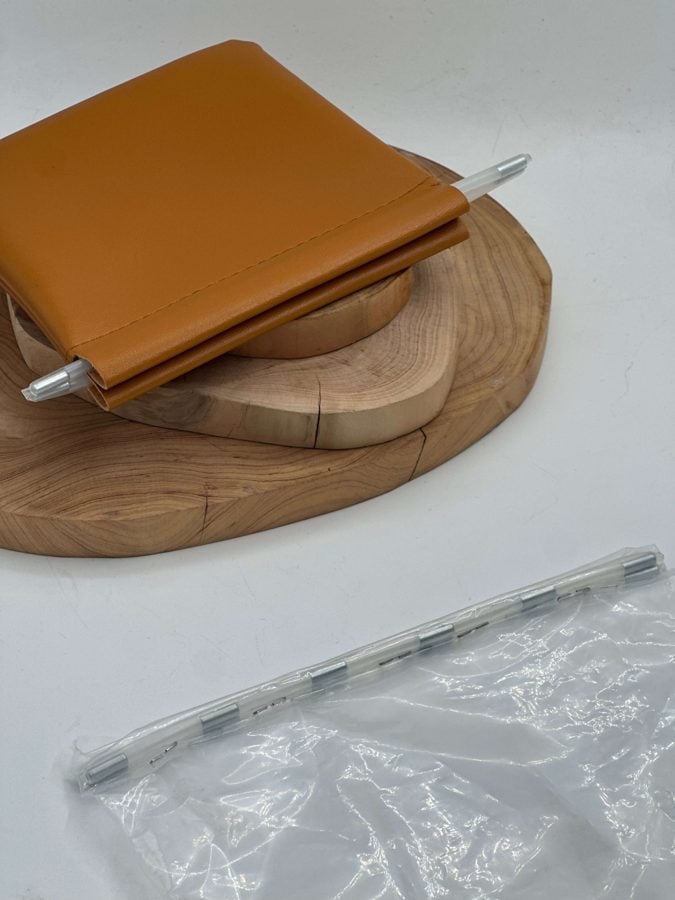
The tube is sealed only at the two ends; there are no compartments along its length. Each magnet can turn slightly in place so the strip can bend, but the whole row is held between the two end seals.
Magnet arrangements: MMM, MMS and MSM
This is how we describe arrangements, using M for a magnet and S for a spacer. The arrangement is the main way to trade closing strength against flexibility.
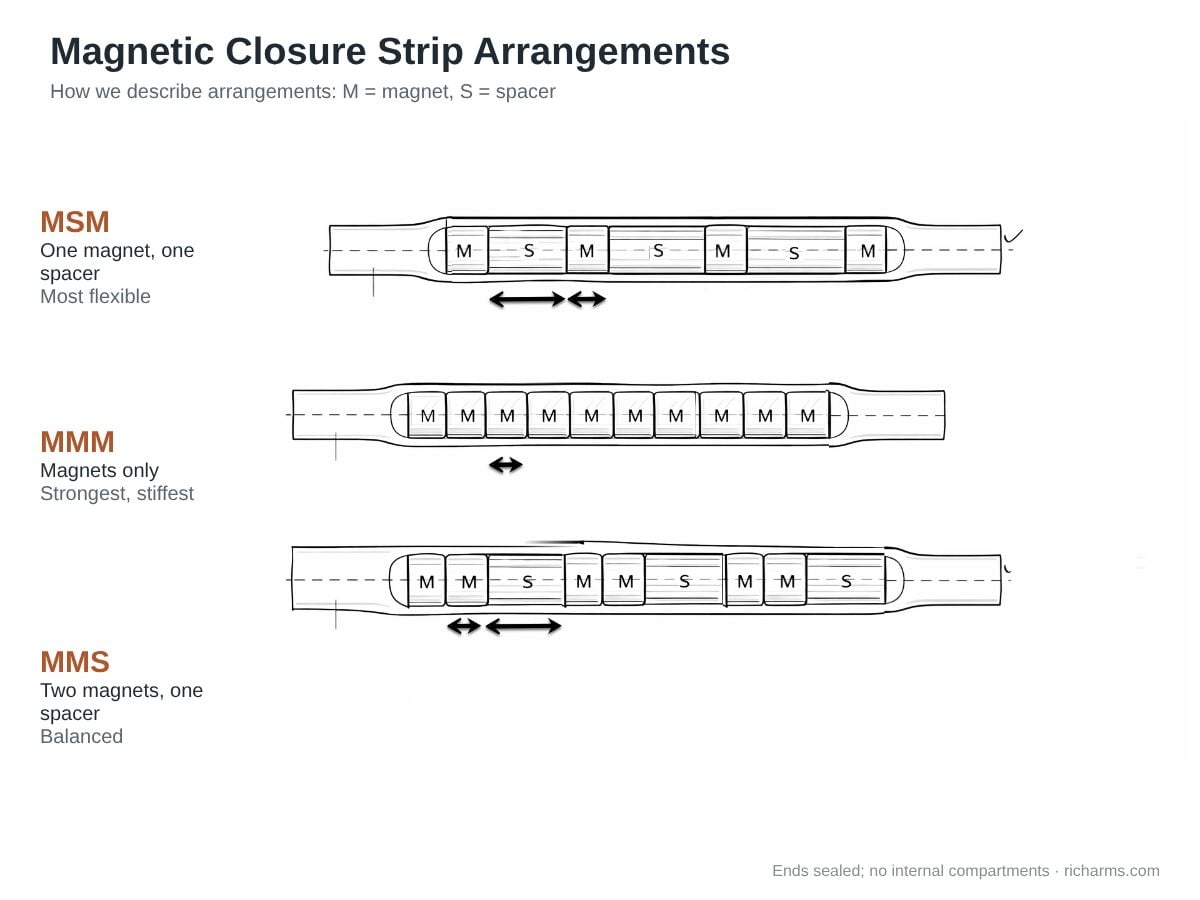
| Arrangement | Layout | Closing continuity | Flexibility | Suits |
|---|---|---|---|---|
| MMM (all magnets) | Magnets in a continuous row | Highest; even along the whole length | Stiffest | Straight openings that need a firm close |
| MMS (grouped) | Two magnets, then one spacer | Medium; closes in sections | Medium | Bag openings that need both hold and bending |
| MSM (alternating) | Magnet and spacer alternate | Lower; closes at points | Softest | Curved openings and soft areas |
The spacing and the number of magnets in each group can also be adjusted for the project.
Where magnetic closure strips fit, and where they do not
Magnetic closure strips suit bags and accessories that are not washed, or are washed rarely. For garments that need machine washing or dry cleaning, we do not currently recommend PVC or EVA tubes.
| Uygulama | Conditions | Tube | Arrangement | End seal | Our view |
|---|---|---|---|---|---|
| Bag front opening | Not washed; opened and closed often | PVC / EVA / TPU | MMM or MMS | Heat-closed tube ends | Recommended |
| Bag pockets and inner pockets | Not washed; opening bends often | PVC / EVA / TPU | MSM or MMS | Heat-closed tube ends | Recommended |
| Laptop sleeves and organizer pouches | Not washed | PVC / EVA / TPU | MMS | Heat-closed tube ends | Recommended |
| Luggage lining compartments | Not washed | PVC / EVA / TPU | MMS | Heat-closed tube ends | Recommended; size confirmed to the case |
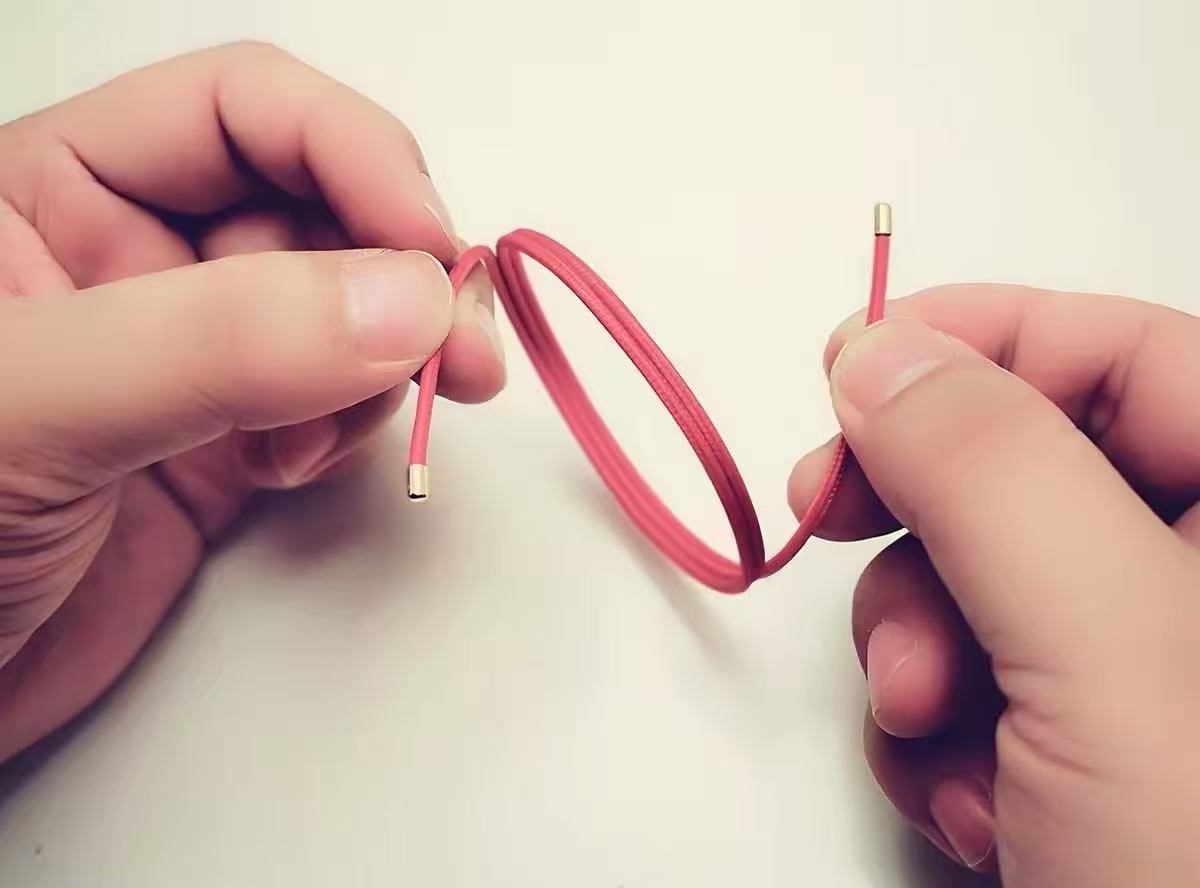
| Jewelry cords and bracelets | Worn; contact with sweat | Plastic tube with braided cover | MMM | Metal end caps | Recommended |
| Hat openings | May be hand washed | Assessed per project | MSM | Assessed per project | Decided after testing with the actual washing method |
| Garments that are machine washed or dry cleaned | Detergent, solvent, tumbling | PVC / EVA not recommended; other materials need project testing | Arrangement does not solve this | — | Not recommended for production at this stage |
One point needs to be clear: MSM and MMS make a strip softer, but they do not prevent a tube from deforming during washing. For garment projects, start by telling us the washing method. We make samples and run a wash comparison before giving a recommendation.
Why magnets can shift inside a strip
Whether magnets move along the tube depends less on friction against the tube wall and more on whether there is spare axial space inside it. What follows is our analysis based on the structure, not a measured result.
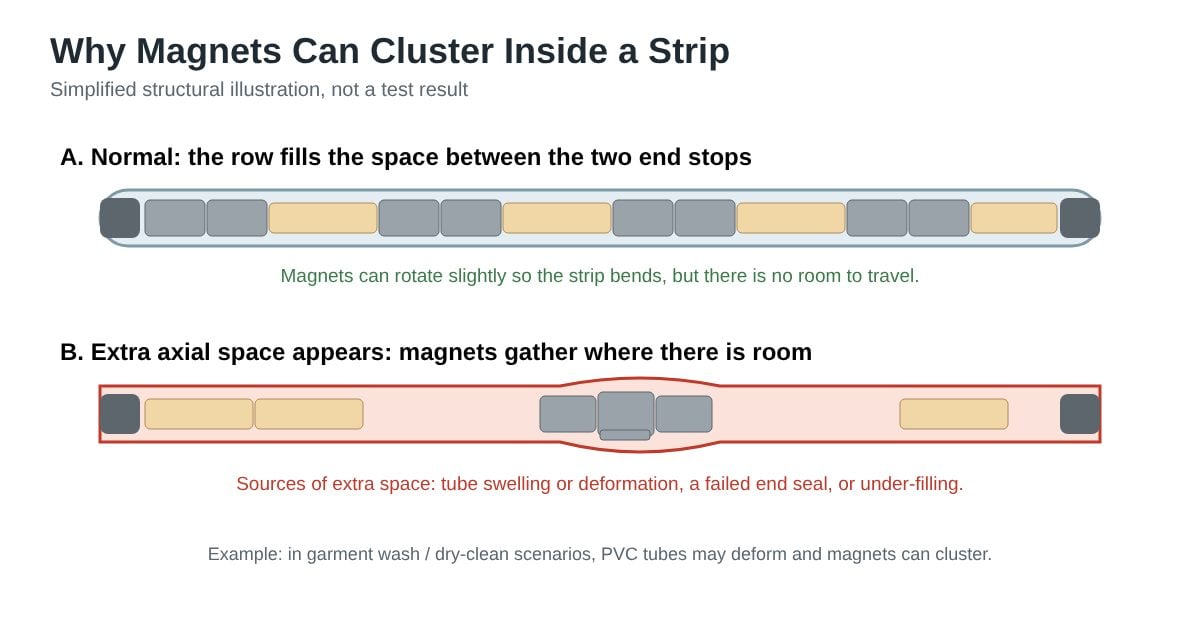
Why they normally stay in place
- Magnets and spacers run from one end to the other and essentially fill the inside length of the tube.
- The end seals hold the row at both ends.
- Neighbouring magnets attract each other and, with the spacers, act as one row.
- So each magnet can turn slightly to let the strip bend, but there is nowhere for it to travel.
When they can cluster
If spare space appears inside the tube, magnets tend to gather where there is room. In our analysis there are three common sources.
| Source | Typical situation | How we address it |
|---|---|---|
| Tube deformation | Detergent or dry-cleaning solvent makes the tube swell or deform, widening it locally | Choose the tube for the use environment; test before production on any project that will be washed |
| End seal failure | The end closure loosens or a metal end cap comes off | Choose the end seal for the pulling and bending the product will see |
| Under-filling | The total length of magnets and spacers is clearly shorter than the inside length of the tube | Set the number of magnets and spacers from the actual finished length |
This pattern has been seen in the industry. In garment wash or dry-clean scenarios, PVC tubes may deform and magnets can cluster, so the strip forms bulges along its length. That is the sequence described above: the tube deforms, spare space appears, and the magnets gather. It is why we validate washing before discussing production for any garment use.
Where a project needs it, we can compare samples before and after the customer’s specified washing method and record magnet position, tube dimensions and closing behaviour.
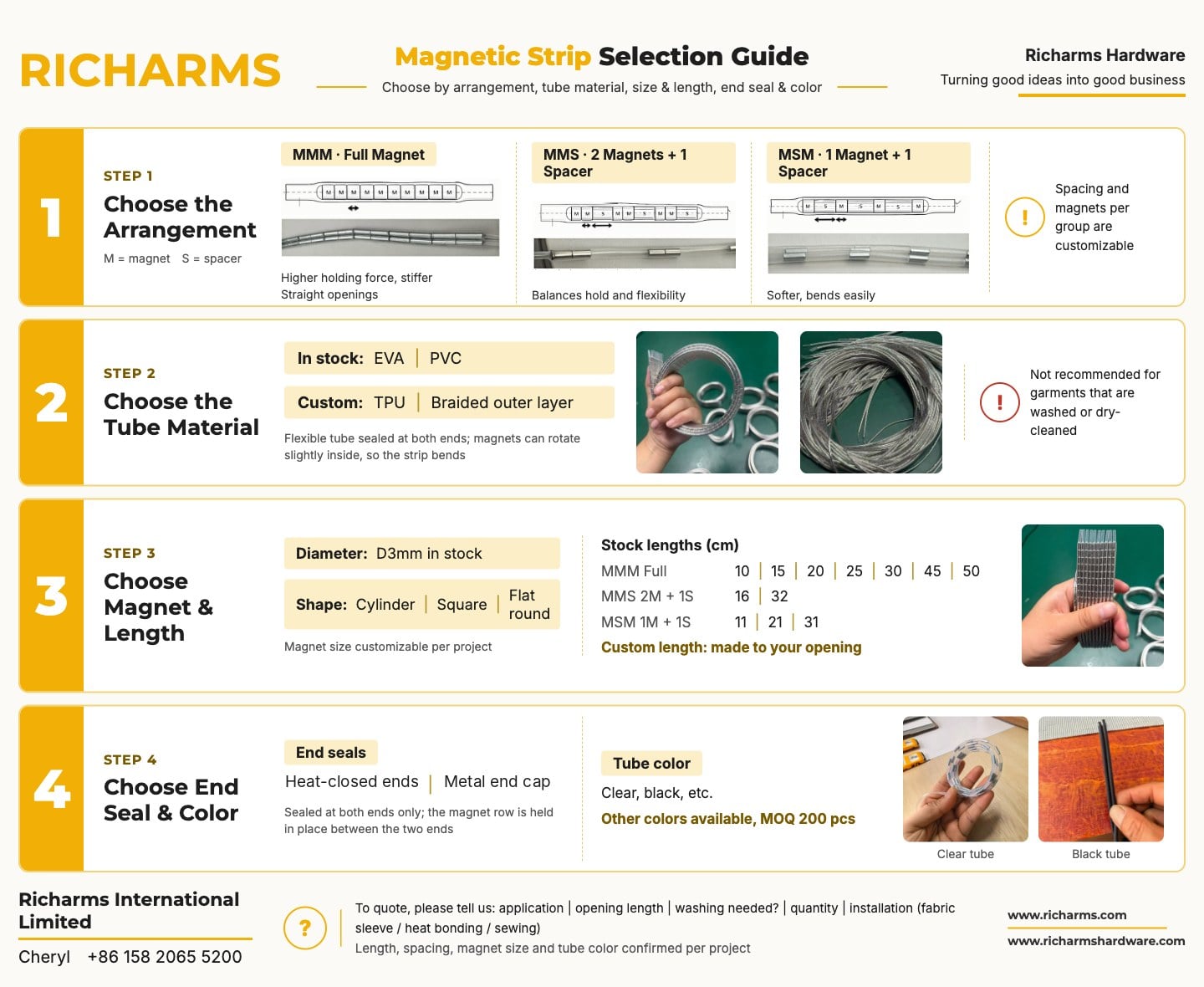
Magnetic strip selection guide: arrangement, tube material, magnet and length, end seal and color.
What to send us for a custom magnetic closure strip
With the following details we can recommend a tube, arrangement and end seal, and arrange samples:
- Where the strip goes and the product type: bag opening, pocket, luggage lining, jewelry, garment, or other.
- Strip length, and whether the opening is straight or curved.
- Whether the product will be washed or dry cleaned, and how.
- Requirements for closing feel, hand feel and appearance: clear, coloured or braided cover.
- Installation method: slid into a fabric channel, heat-bonded or sewn in.
How a project usually runs:
- You send the details above.
- We suggest a configuration and tell you which uses we would not recommend.
- We make samples for you to test in your product.
- For products that will be washed, we run a comparison using your washing method.
- Production starts after you confirm the sample.
Frequently asked questions
Is a magnetic closure strip the same as a magnetic zipper?
Many buyers call it a magnetic zipper, but there are no teeth or slider. It is a flexible tube with magnets inside that closes by attraction along the opening.
Which arrangement should I start with?
For a straight opening that needs a firm close, start with MMM. For an opening that has to bend, start with MMS. For a curved or very soft area, start with MSM. Confirm the choice on a sample in your own product.
Can the strip be used on clothing?
Not with PVC or EVA tubes on garments that are machine washed or dry cleaned. Other materials need project testing with the actual washing method before any recommendation.
Can you publish closing-force values?
Closing feel depends on the magnets, arrangement, tube and the product it is built into. Rather than quote general figures, we test samples for the project.
Talk to us about your opening
If you are replacing a zipper or snaps, or want a hidden magnetic closure on a bag, pouch or luggage lining, send your details to info@richarms.com. You can also see our flexible tube magnetic closure product page, or read about sew-in magnetic closures for other hidden closure options.

 Turkish
 English
 French
 Italian
 Portuguese
 Spanish
 Korean
 Japanese
 German
 Dutch