
Choosing the right magnetic snap fastener for a bag depends on three main factors: the bag’s material, the closure size, and the magnetic holding force. A well-matched snap should close securely without stretching, tearing, or distorting the leather.
This guide explains the main types of magnetic snaps, how to select their strength and size, and how to install them for reliable long-term performance.
What Is a Magnetic Snap Fastener for Bags?
A magnetic snap fastener is a two-part closure system that uses attraction between magnets—or between a magnet and a ferromagnetic metal plate—to keep a bag flap closed. It is commonly used on handbags, wallets, totes, clutches, messenger bags, and small leather goods.
How Does a Magnetic Snap Work?
Most magnetic closures include:
A magnetic component installed on the flap.
A matching metal plate or magnetic component installed on the bag body.
Back plates, prongs, or stitching that secure the hardware to the leather.
When the two halves come close, the magnetic field pulls them together and holds the flap shut. Opening the bag requires pulling the two parts apart.
The magnet’s performance depends on more than its grade. Air gaps, leather thickness, hardware alignment, metal components, and the direction of the pulling force all affect the final holding strength.
Why Are Magnetic Snaps Popular in Leather Bag Design?
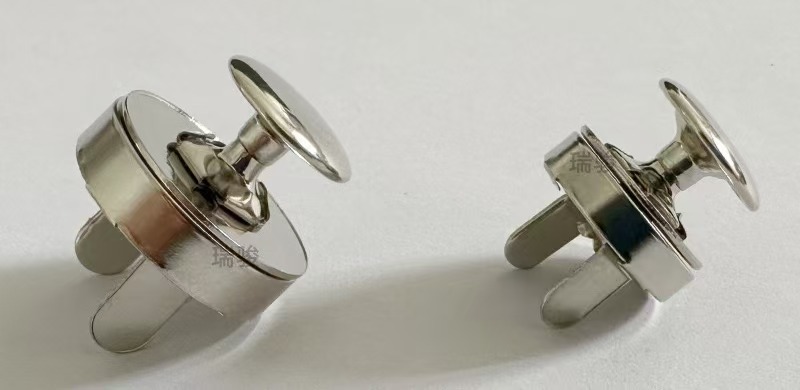
Magnetic snaps are popular because they offer:
Fast, one-handed opening and closing.
A clean appearance with relatively compact hardware.
Less noise than many mechanical closures.
Flexible placement beneath leather or lining.
A convenient alternative to zippers, buckles, and turn-locks.
They are especially suitable for bags that need quick access. However, magnetic snaps may be less suitable than a zipper or turn-lock when maximum security is important.
Different Types of Magnetic Snap Fasteners for Leather Bags
Prong Magnetic Snaps
Prong magnetic snaps are among the most common options for leather bags. The hardware usually includes a magnet, a matching plate, and metal prongs that pass through the leather and fold over a backing plate.
They are a practical choice for:
Handbags.
Tote bags.
Wallets.
Fabric-lined leather bags.
Small production runs.
Their main advantage is simple installation. Their main weakness is that the prongs can pull through soft or thin leather if the installation area is not reinforced.
Sew-In Magnetic Snaps
Sew-in magnetic snaps are enclosed in fabric, leather, or a small casing and attached with stitching. They are useful when you want to avoid visible prongs or reduce stress concentrated at a few small points.
They work well for:
Soft leather.
Quilted bags.
Padded flaps.
Fabric-lined designs.
Closures requiring a discreet finish.
Sew-in versions may take longer to install, but they can distribute stress more gently than prong hardware.
Hidden Magnetic Closures
Hidden magnetic closures are installed between layers of leather, beneath the lining, or inside a dedicated pocket. They create a minimalist appearance because little or none of the hardware is visible.
They are often used in:
Luxury handbags.
Structured flaps.
Minimalist leather goods.
Designer-style concealed closures.
The trade-off is that hidden installation requires more accurate pattern-making. If too many layers separate the two halves, the magnetic force may become insufficient.
How to Choose the Right Magnetic Snap Strength
Understanding Magnet Grades
Magnet grades such as N35, N42, and N48 describe the maximum energy product of neodymium magnet material. A higher grade generally indicates a stronger magnet of the same size and shape.
In practice:
N35 is suitable for light closures and thin materials.
N42 provides a stronger, versatile option for many handbags and medium-weight leather.
N48 offers higher performance when the closure must work through thicker layers or resist more opening force.
Magnet grade alone does not determine the finished snap’s performance. A larger N35 magnet can hold more strongly than a very small N48 magnet. Product specifications such as pull force, diameter, thickness, and working distance are therefore essential.
How Magnet Strength Affects Bag Performance
A snap that is too weak may:
Open when the bag is moved.
Fail to stay closed when the bag is full.
Allow the flap to lift or gape.
Produce an unreliable user experience.
A snap that is too strong can also create problems:
The flap may be difficult to open.
The leather may be pulled or creased.
The hardware may gradually loosen.
Users may yank the flap instead of opening it gently.
The goal is not maximum magnet strength. The goal is enough holding force for the bag’s normal load, with a comfortable opening action.
Choosing Magnetic Strength Based on Bag Material and Size
Consider the following general starting points:
These are starting guidelines rather than universal specifications. Always test a sample with the final leather, lining, reinforcement, and typical contents.
How to Choose the Right Magnetic Snap Size
Common Magnetic Snap Sizes for Different Bags
Magnetic snaps are commonly available in approximate diameters such as:
10–12 mm for small wallets and pouches.
14–18 mm for clutches and compact handbags.
18–20 mm for general-purpose handbags.
20–25 mm for larger bags and wider flaps.
The ideal size depends on the bag’s scale and design. A small snap may look refined on a compact purse but appear visually inadequate on a large tote. Conversely, oversized hardware can make a small bag look unbalanced.
The Relationship Between Snap Size and Holding Force
A larger magnet often provides more holding force because it has a larger contact area and can contain more magnetic material. However, size does not automatically guarantee better performance.
Holding force decreases when:
The two halves are misaligned.
Leather or lining creates a large gap.
The magnet contacts a thin or poorly matched metal plate.
The closure is pulled sideways rather than directly apart.
The leather flexes around the hardware.
A moderate-sized snap installed close to the surface and aligned accurately may outperform a larger snap installed through several thick layers.
Magnetic Snap Installation Guide for Leather Bags
Reinforcing the Installation Area
Reinforcement is essential, particularly for prong snaps. Without it, repeated opening and closing can enlarge the holes or tear the leather.
Suitable reinforcement materials include:
Leather patches.
Bag stiffener.
Woven interfacing.
Synthetic reinforcement sheets.
Thin plastic or metal washers.
Firm backing leather.
The reinforcement should extend beyond the hardware footprint so the pulling force is spread across a broader area.
For soft leather, avoid relying on the leather alone to hold the prongs. For structured bags, place the reinforcement between the outer leather and lining where it will remain hidden.
Adjusting Leather Thickness for Better Magnetic Performance
Leather thickness affects both attachment strength and magnetic performance. Thick leather may provide excellent support but can create too much distance between the two magnetic halves.
If the leather stack is too thick:
Use a stronger snap.
Reduce unnecessary layers around the closure.
Skive or thin the leather locally where appropriate.
Install the magnet in a recessed area.
Choose a closure designed for thicker materials.
Do not thin leather so aggressively that the installation area becomes weak. The correct solution balances a short magnetic gap with adequate structural support.
Proper Magnetic Snap Positioning and Alignment
Accurate positioning is one of the most important installation steps.
Mark the centerline of the flap and bag body.
Place the two snap halves together.
Apply a small amount of marking chalk or removable transfer medium to one side.
Close the flap to transfer the exact position.
Check alignment from the front and side.
Install the hardware with reinforcement.
Test the closure before permanently finishing the lining.
The two halves should meet face-to-face rather than at an angle. Even a small offset can reduce the effective holding force and cause uneven stress on the leather.
Magnetic Snap vs Traditional Bag Closures
Magnetic Snap Advantages and Disadvantages
| Closure type | Vantagens | Disadvantages |
|---|---|---|
| Magnetic snap | Fast, quiet, compact, easy to operate | Can open under heavy load; may affect magnetic stripes |
| Zíper | Strong security and full closure | Requires more installation skill and two-handed operation |
| Turn-lock | Decorative and secure | Slower to operate and requires accurate alignment |
| Buckle | Adjustable and visually distinctive | Less convenient for frequent access |
| Mechanical snap | Positive physical engagement | Can require more force and place stress on the leather |
Mechanical Snap vs Magnetic Snap: Which One Is Better?
A mechanical snap uses physical components that lock together, while a magnetic snap relies on attraction. Neither is universally better.
Choose a magnetic snap when:
The bag needs quick access.
The design calls for a clean, understated closure.
The load is light or moderate.
One-handed operation is important.
Choose a mechanical closure when:
The bag will carry heavy contents.
Security is a major concern.
The flap must remain closed during vigorous movement.
The design benefits from a visible locking action.
For some bags, a magnetic snap can be combined with a zipper compartment or secondary fastening system.
Are Magnetic Snap Fasteners Safe for Credit Cards?
How Magnetic Fields Affect Magnetic Stripe Cards
Magnetic fields can affect the encoded information on magnetic-stripe cards. This includes some older cards, hotel key cards, access cards, gift cards, and other cards that depend on a magnetic stripe.
Modern high-coercivity stripes are more resistant than older low-coercivity stripes, but direct and prolonged contact with a strong magnet is still best avoided. The magnetic stripe stores static information magnetically, which is why it is the vulnerable part of the card.
Difference Between Magnetic Stripe Cards and Chip Cards
EMV chip cards do not store payment data in the same way as a magnetic stripe. The chip itself is an electronic circuit and is not erased by the static magnetic field from an ordinary bag closure. Contactless payment functions also rely on electronic and radio-frequency components rather than magnetic data storage.
However, a card may still have both a chip and a magnetic stripe. Even when the chip remains functional, the stripe could potentially be affected.
How to Protect Cards When Using Magnetic Closures
For extra caution:
Keep the magnetic stripe facing away from the closure.
Avoid storing a card directly against the magnet for long periods.
Use a separate card sleeve or compartment.
Keep hotel keys and access cards away from strong magnetic hardware.
Choose a closure with moderate rather than unnecessarily excessive strength.
The practical risk to the chip is negligible, but protecting magnetic-stripe cards remains sensible.
Common Problems With Magnetic Snap Fasteners and Solutions
Why Is My Magnetic Snap Not Strong Enough?
Possible causes include:
The snap is too small for the bag.
The magnet grade or pull force is insufficient.
Too many layers separate the two halves.
The components are misaligned.
The metal plate is not properly matched.
The bag is overfilled.
The flap is being pulled sideways.
Try reducing the closure gap, improving alignment, using a stronger or larger snap, or adding a second closure. Test the completed bag rather than the loose hardware alone.
Why Does the Magnetic Snap Damage Leather?
Damage usually occurs because the force is concentrated in a small area. Common causes include:
No backing plate or reinforcement.
Thin, soft, or stretchy leather.
Prongs folded too tightly or unevenly.
A magnet that is stronger than necessary.
Repeatedly pulling the flap sideways.
Hardware installed too close to an edge.
Use a larger reinforcement patch, firmer backing material, or a sew-in design. Keep the snap far enough from the edge to leave a stable margin of leather.
How to Improve Magnetic Snap Durability?
For better long-term performance:
Reinforce both snap locations.
Round sharp edges on backing materials.
Keep the two halves aligned.
Avoid overfilling the bag.
Use hardware with a protective finish.
Test repeated opening and closing before production.
Inspect the leather around the closure after stress testing.
For commercial production, test the snap with the exact leather and lining combination used in the finished product. Hardware performance can change significantly between thin lambskin, vegetable-tanned leather, chrome-tanned leather, suede, and synthetic leather.
How to Choose the Best Magnetic Snap Fastener for Your Leather Bag?
Consider Your Bag Material
Soft leather needs broad reinforcement and moderate magnetic force. Thick or structured leather can support larger hardware, but the total closure thickness may require a stronger magnet.
Also consider stretch, grain direction, lining material, and whether the leather will soften with use.
Match the Snap Size and Magnet Strength
Select the smallest snap that provides dependable closure without looking undersized. Then choose the magnet strength based on:
Bag dimensions.
Flap width.
Leather and lining thickness.
Expected contents.
Closure gap.
Desired opening effort.
Do not select solely by the N-grade. Compare the manufacturer’s pull-force specification and test the complete assembly.
Choose the Right Installation Method
Choose a prong snap for straightforward installation.
Choose a sew-in snap for soft or delicate materials.
Choose a hidden closure for a minimalist appearance.
Choose multiple snaps for a wide flap or large tote.
Use reinforcement whenever the leather is thin, flexible, or highly stressed.
Conclusion: Choosing the Right Magnetic Snap for Better Bag Quality
The best magnetic snap fastener for a leather bag is one that balances appearance, holding force, installation method, and leather protection. Start by matching the snap type to the construction, choose an appropriate diameter, and evaluate the magnet’s actual pull force rather than relying only on its grade.
For dependable results, reinforce the leather, minimize the gap between the two halves, and align the closure carefully. Finally, test the finished bag under realistic conditions—including normal contents and repeated opening—before approving the hardware for production.



 Portuguese
  English
  French
  Italian
  Spanish
  Turkish
  Korean
  Japanese
  German
  Dutch
Dutch