When a magnetic snap is fixed with prongs, the legs have to pass through the finished material and then be bent to hold the snap in place. If the prongs are longer than the stack needs, they can overlap excessively, raise the covered surface or leave a bulky set point. If they are too short, they may not close through leather, canvas, reinforcement and lining. The useful question is whether the leg length matches the stack that will actually be set in production.
This article compares short prong magnetic snaps and long prong magnetic snaps as two published options for that decision. It is not a guide to rivet or post length, even though both must be judged against the finished article rather than a single outer panel.

Why the finished stack is the reference, not the outer panel
A flap, box lid or bag panel is rarely one layer at the set point. Reinforcement, a lining, a turned edge or a hidden carrier can add thickness after the first cutting ticket has been issued. A prong length that looked sufficient on a leather swatch may be short once those layers are present, or excessive on a thinner production batch.
The published guidance on both product pages is consistent: the correct prong style depends on total material thickness, reinforcement layers, washer configuration and the desired bending direction. Sample testing is recommended for every new material combination, because compression and reinforcement can affect the final fit. If a later material batch changes thickness or firmness, repeat the fitting check.
More setting force is not a reliable remedy for a prong of the wrong length, or for a washer and support profile that do not suit the stack.
When a short prong is the layout to evaluate
Short prong magnetic snaps are described for thin leather, fabric, coated paper, covered boxes and other applications where standard prongs may be longer than necessary. On thin material, standard prongs may overlap excessively after they are bent inward, creating a thicker installation area or a bulge on the covered surface. Shorter prongs require less bending space and can provide a flatter installation when matched with a suitable material thickness.
Typical applications listed for the short-prong option include thin leather and synthetic leather, fabric handbags and wallets, fabric-covered gift boxes, pencil cases, lightweight packaging and small leather goods.
The displayed 18 mm short-prong configuration on the live product page uses a 7.1 mm prong length, with a brass shell, steel backing components and an NdFeB magnet. Component dimensions and available finishes are given for that displayed configuration. Those figures should be confirmed against the approved sample before production; they should not be treated as a universal short-prong standard for every size or finish.
Available finishes listed for that configuration include gold, antique brass, light rose gold and custom finishes. Different magnetic holding-force options can be supplied according to the opening feel, product structure and material strength required by the customer.
When a long prong is the layout to evaluate
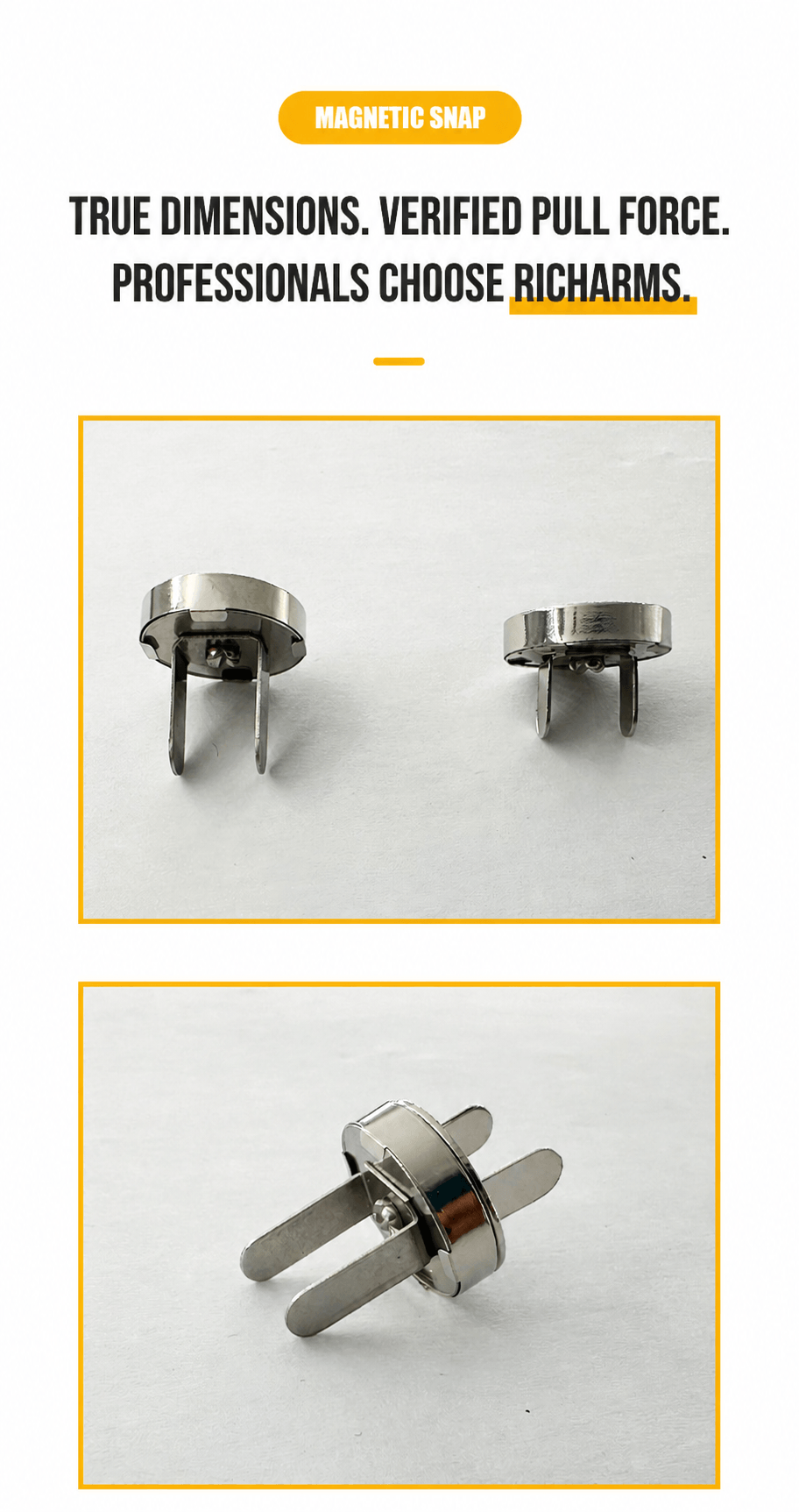
Long prong magnetic snaps are the extended-prong option in the classic round magnetic snap range. They are offered for applications where a standard prong may not provide sufficient installation depth, including thick leather, canvas, multilayer fabrics and reinforced product structures. The published page also mentions fabric-covered boxes, presentation packaging and other structures in which the snap must pass through a thicker material stack.
The long-prong product page describes an installation trial on a measured 6.8 mm stack, and notes that an additional allowance may be workable, subject to compressibility, washer selection and sample testing. It also gives more than one prong-length figure for related configurations. Because those figures are not presented as a single current standard, this article does not repeat a long-prong length as a specification. Use the current product drawing and confirm the length on the actual material thickness before mass production.
Component options published for the long-prong range include a female snap in steel, brass or stainless steel, a male component in steel, and washer and finish choices selected according to thickness, corrosion requirement, target price and product positioning. Standard ferrite magnet configurations are available for general applications, and stronger neodymium configurations can be developed when greater holding force is required. The complete product should be tested to confirm opening force and material load capacity. Colour, finish and logo options are subject to artwork and order requirements.
Inward and outward bending still have to be trialled
Prong length and bending direction are related, but they are not interchangeable decisions. An inward bend keeps the prongs within the washer area. Short prongs are particularly useful when an inward bend is required on thin material, because they can reduce excessive overlap. An outward bend distributes the prongs towards the outer edges. That method requires sufficient installation space and should be tested with the actual material and reinforcement structure.
The same caution applies to a long prong on a thick stack. Extra length does not automatically make every bend direction viable. The trial should include the washer, the support under the set point, and the visible face after closing.
A practical shortlist for matching leg length
- Measure the finished stack at the set point, including reinforcement, lining and any hidden carrier.
- Note how much the stack compresses under a setting trial, rather than relying only on a calliper reading of the loose layers.
- Decide whether the main risk is excess overlap and surface bulging, or insufficient length through the assembly.
- Shortlist a short-prong configuration for thin leather, fabric or covered-box work, or a long-prong configuration when a standard prong may not reach through the stack.
- Confirm the current displayed dimensions, materials and finish against the product page and the approved sample. Do not copy a length from a previous style without a new check.
- Trial the intended inward or outward bend on scrap that represents the production stack.
- Inspect the set for a flat visible face, a stable washer seat, and prongs that close without competing with nearby seams or hardware.
- Check fixing reliability and magnetic closure force separately, and send material type, total thickness, colour, holding-force requirement, quantity and any logo details with the sample request.
Final specifications should be confirmed through an approved sample before mass production. If the stack changes later, restart the fitting check even if the snap model stays the same.
Richarms is a magnetic snaps manufacturer and custom bag hardware factory founded in Foshan, China, in 2003.

 English
 French
 Italian
 Portuguese
 Spanish
 Turkish
 Korean
 Japanese
 German
 Dutch